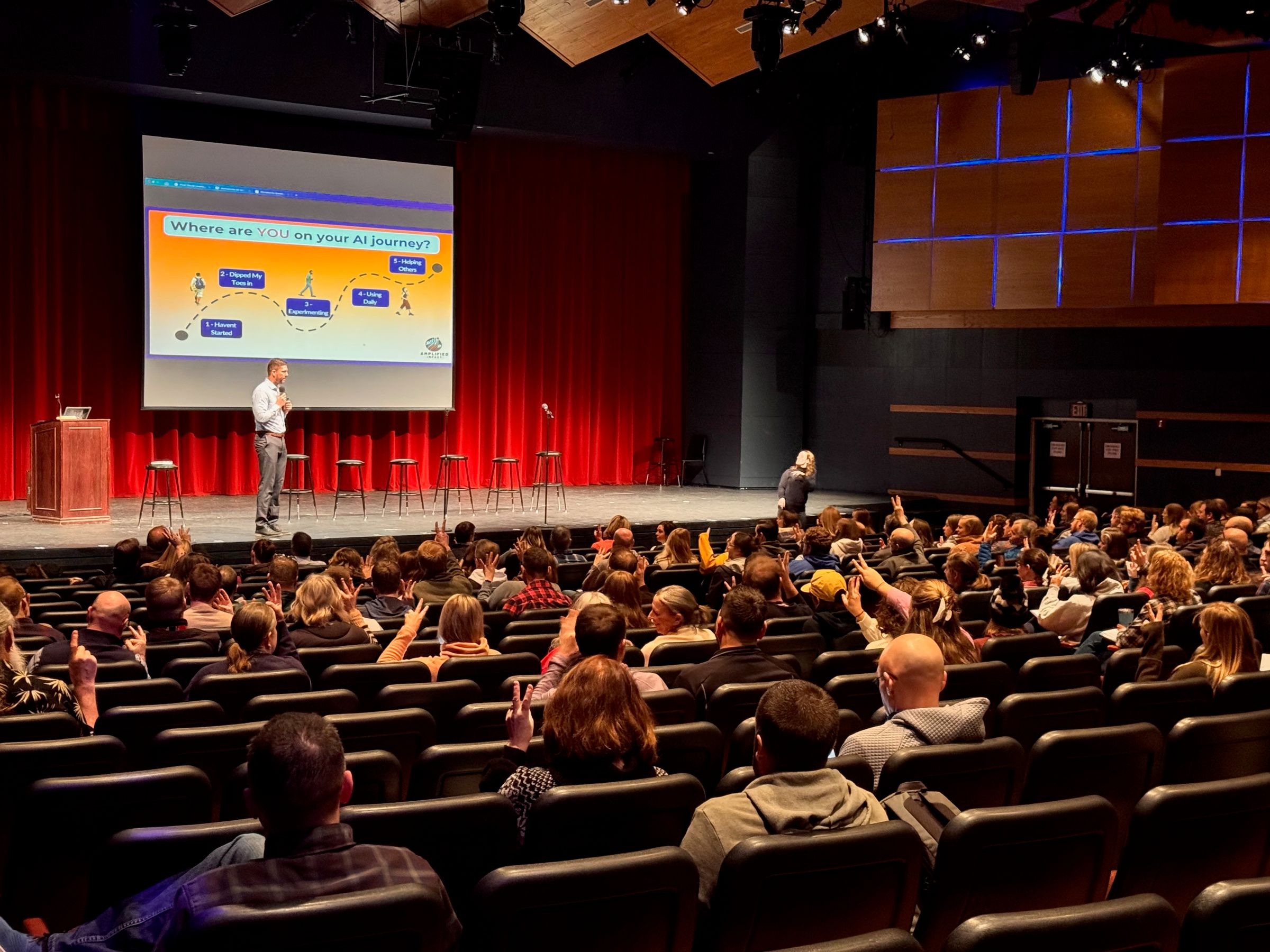
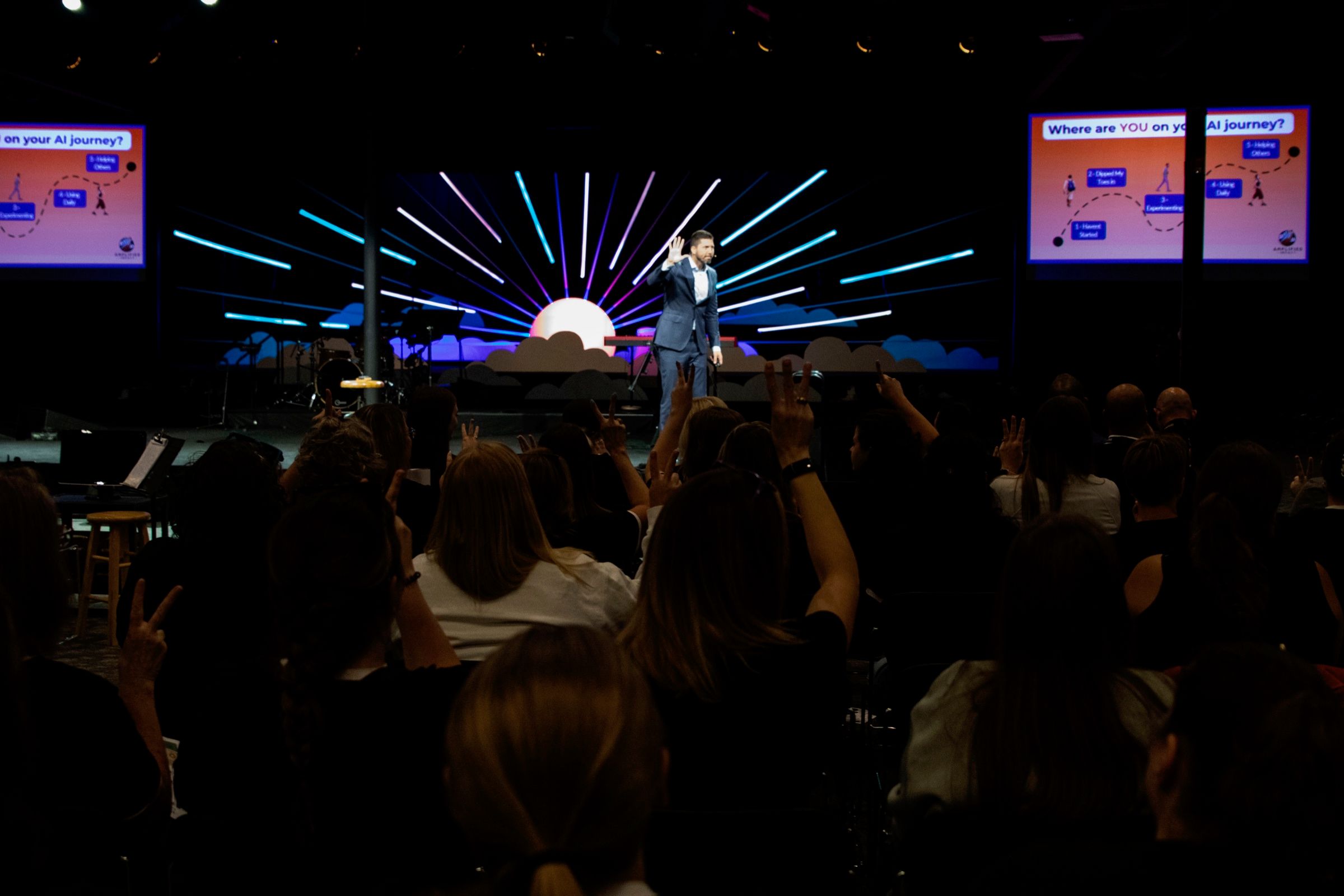
Keynotes that get people using AI before they're back at their desks.
Nobody sits through a lecture. Every keynote is hands-on, customized to your audience, and designed by a learning scientist who specializes in AI. Your people won't just hear what's possible, they'll try it before they leave the room.
Twenty-five seconds on why you don't need to be techie to be great with AI.
Read the transcript
"That is the amazing thing about generative AI, is you don't need to be really good at tech to be really good at leveraging AI. You do know, though, need to be a good communicator, because it uses something called natural language processing. Which is, essentially, you talk to it like you talk to a person, and you just need to know how to communicate well to get those outputs."
From a school district keynote, March 2026. Captions are open (burned into the video).
Keynotes and modules, rebuilt for every room.
Start with a keynote, then stack the modules that fit your day. Each one has a spine that works, rebuilt around your audience: their examples, their tools, their world.
Flagship keynote: corporate and leadership
The AI-Leveraged Leader: Practical Tools and Techniques for Exceptional Results
This is the talk I'm asked for most, delivered to corporate teams, government agencies, YPO forums, and associations: my favorite eight everyday AI use cases, the nine biggest mistakes people make with AI, and a framework that helps you communicate with AI in a human-centered, responsible way. It's hands-on within the first few minutes, so nobody just watches me demo. Skeptics get the same seat as everyone else in the room, and they're usually the ones asking the sharpest questions by the end.
Co-keynote with Dan Oblinger
EQ + AI: Leading with Clarity
I share the stage with Dan Oblinger, a hostage negotiator who teaches emotional intelligence. We take one leadership scenario every room recognizes and work it with five strategies that combine EQ and AI, so you watch both sides solving a problem together. It sounds like an unlikely pairing until you see a room full of engineers lean in.
This was an unlikely combination of topics that went well together. Both presenters were experts in their fields and spoke in terms the layman could comprehend. I left after a full day of training wanting more and knowing where to find more.
One thing that Tyler's taught me is the power of using AI for EQ kinds of things. So conversations, dialogue, strategizing about personnel issues, strategizing about conflict or negotiations.
Keynote: educators and higher ed
Teaching with AI: 7 Habits to Amplify Learning
Seven habits that keep students doing the thinking while AI amplifies the learning, grounded in the Intentional Intelligence Scale and two decades in classrooms. Educators leave with design moves they can use in Monday's lesson, not a philosophy debate.
Modules go deeper on one skill at a time.
Module: hands-on
Prompt CRAFTing Skillsets
The framework people tape next to their desks. One page that helps you better communicate with AI in a human-centered, responsible way, practiced live on your own work until it sticks. What makes it different is the mindsets built into it, not just the prompting steps.
Module: full day, hands-on
AI Workshop Labs
Rotating labs built around your team's real projects: writing, analysis, research, ideation, automation. Your people build working tools in the room and leave with a team-specific prompt library, plus notes to re-run the labs without me. Built for teams that already have the foundation down.
Module: practice lab
AI-Assisted Skill Practice
Practice the hard conversation before you have it. AI plays the other side in realistic role-play, with feedback, so the rehearsal happens in a safe place and the real thing goes better. Teams use it for coaching conversations, tough feedback, and high-stakes moments.
Custom builds
Don't see your audience here?
Neither did rural hospital leaders, until the California Hospital Association asked. We built "Empowering Rural Hospital Leaders with AI: Practical Tools and Techniques for Exceptional Results" around their exact world: everyday hospital use cases, what responsible use looks like in their setting, and live demos on the tools their teams already had.
Every keynote gets that same treatment. Your audience, their work, their examples.
Brittany Rowe was in the audience for a Thursday morning keynote. Less than 48 hours later, she sent this.
I was in the audience Thursday morning when you gave your keynote presentation... I have literally dove headfirst into AI, and I'm still in disbelief about what's possible.
In less than 48 hours I've accomplished things I can't even wrap my head around. I have had a business idea for the last 6 months and on my drive home... I basically mapped out an entire new business... Just from talking on my drive home!
You completely opened my eyes to something I never understood before. The fact that we can accomplish things that seemed impossible just days ago - it's mind-blowing... Your presentation genuinely changed the trajectory of my life.
NPS 79, zero detractors (ACEC Utah, full-day event)
76% of attendees gave it a perfect 10
AI confidence up 62% in one day
Most keynotes get measured in applause. I measure mine by what people do after.
Planners, this part is for you.
A pre-event call, every time.
I learn your audience, your theme, and what you need the room saying on the drive home.
In person or virtual.
Both formats are hands-on. The virtual version is built for engagement, not endurance.
Cross-platform.
ChatGPT, Claude, Gemini, Copilot. The talk works with whatever your attendees already have on their devices.
A post-event survey, included.
You'll have numbers to share with your board, not just anecdotes.
I learned about Amplified Impact by attending a Young Presidents Organization (YPO) event on artificial intelligence. I was so impressed, I reached out to Tyler immediately after because I wanted my company to have access to the same wisdom shared with dozens of executives.
Audiences include
ACEC Minnesota
ACEC Arizona
ACEC Utah
YPO
Wyoming Hospital Association
California Hospital Association
Twin Cities NECA
Normandale Community College
Altana FCU
MSBA
Have a date and an audience in mind?
Tell me about the event, the audience, and what you want people walking out ready to do. You'll get a fit-or-no-fit answer within 24 hours, and if I'm not the right speaker for your room, I'll tell you that too.